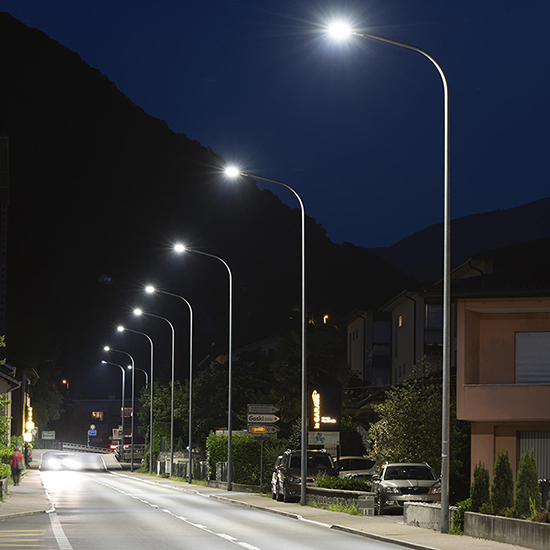
LED street lighting
The use of LED street lighting is increasing in the streets of our world. One reason is that it uses the latest technology and has many advantages over other types of lighting.
Street lighting is an important element in the infrastructure of modern cities. It originated in western Europe in the 17th century to reduce crime at night and improve transportation. Street lighting was the most common liquid fueled ones. Until electricity was invented, of course.
With the invention of electricity, incandescent bulbs dominated the street lighting market for many years. Then they were replaced with HID (High-intensity discharge) lamps, which are still in use. This type of bulb is divided into 3 Mercury vapor, metal halide and sodium vapor ampoules.
Mercury Vapor Lamps: They have a white light. It gives 70 Lumens of light per watt. It has a working life of 16,000 hours. These lamps, which were used extensively in the 1990s, were replaced by the other two types due to their low efficiency. And in 2006 its use was banned in the EU.
Metal Halide Lamps: Similar to mercury vapor lamps. It delivers 90 lumens of light per watt. Its most characteristic feature is its excellent color appearance.
Sodium vapor lamps: They are the products with the highest efficiency among HID lamps. It is advantageous with its efficiency of 140 lumens per watt and a lifespan of 24,000 hours. However, the biggest disadvantage is that the light color is a dark yellow to orange color. This causes these products not to be a good option in street lighting.
LED Street Lighting Revolution
After the success of led lighting in interior lighting in recent years, Led Street Lighting products have started to be used from public spaces to streets. The high efficiency of the LEDs, the fact that they offer different color options, long life and much more compact sizes have accelerated the return to these products.
Advantages of Led Street Luminaires
- LED lamps do not emit heat and do not heat up, making them much more fire resistant than high-intensity discharge lamps.
- It is much easier to direct the light of LED luminaires, thus reducing scattering and light pollution.
- Light from LED fixtures can range from warm white to cool white, while light from sodium vapor lamps is always yellow.
- All HID lamps need some time to warm up once turned on, while LED lamps will instantly light up at full brightness.
- Low energy consumption allows LED luminaires to be combined with compact solar panels. Thus, they become even more cost and energy efficient street lighting.